Copy trading fee calculator: three payment models over a year
The copy trading fee calculator reduces a subscription, a success fee and a volume charge to one number — the total for a year. On some inputs one model is cheaper, on others another.
What a subscription to a trader costs per year
Set the deposit, the year's result and the turnover in lots, then the rates of the three models. The table under the chart shows how much each one withholds and what share of the profit is left to you.
| Model | Profit before fees | Fees for the year | Left for you | Share of profit |
|---|
How each model is calculated
Three formulas with no common denominator: one depends on time, the second on the result, the third on how active the strategy is. They can only be compared as money per year.
Cost = monthly fee × 12. It depends on neither the result nor the turnover. The only model that takes money in a losing year — and the only one that adds nothing to a successful one.
a fixed amountCost = profit × rate; on a loss, zero. The calculation applies a high-water mark: the charge is taken only on new account highs. Otherwise, after a drawdown, you would pay a second time to get back to a level already reached.
a share of the resultCost = turnover in lots × rate per lot. It does not depend on the result and grows with the lead trader's activity. For a scalping strategy with hundreds of lots of turnover this is the main expense.
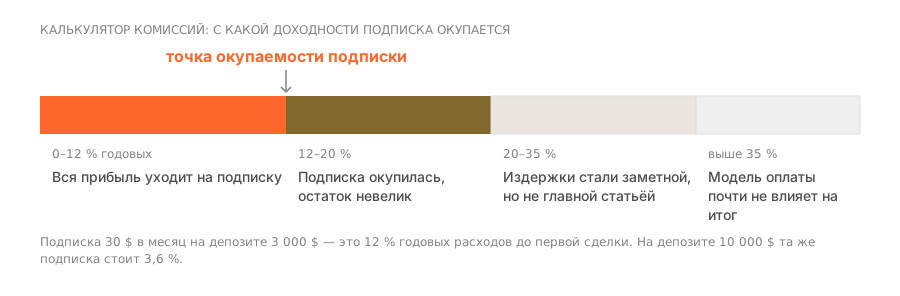
depends on turnoverThe models are equal at a return of r = 12 × subscription ÷ (rate × deposit). At a subscription of 50 $, a rate of 25 % and a deposit of 10,000 $ that is 24 % a year: below it the success fee wins, above it the subscription.
a minute of arithmeticHow to read the result
What the fee calculator does not count
The calculation covers only what goes to the lead trader and the platform. Three expense lines stay outside it, and all three are deducted from your profit before the fee is worked out.
Charged on every trade and independent of the result. On an active strategy it is comparable to the lead trader's fee, and sometimes exceeds it.
on every tradeDebited for every night a position is held. A strategy that holds positions for weeks pays it as many times as there are nights your copy stays open.
for every nightThe gap between the lead trader's price and your fill. It is barely tracked and is not broken out in reports, yet in a thin market it costs more than the spread.
not visible in the reportThe payment system takes its cut whenever money moves. Over a year these are one-off sums, but on a small deposit they are comparable to a monthly subscription.
one-offFrequently asked questions
What is a high-water mark and why is it needed?
It is the rule under which the fee on profit is taken only from new account highs. Without it the lead trader is paid twice after a drawdown: you pay for the fall in losses, and for the return to the old level in a fee on “profit” that does not actually exist.
Which model is cheaper for a beginner?
On a small deposit — the success fee: it takes nothing in a losing year and scales with the result. A fixed subscription only wins at a substantial return and a deposit of several thousand dollars.
Is the fee taken from profit before or after costs?
As a rule, from the trading account's result — that is, after spread and swap but before the platform's charge. The exact base has to be checked in each platform's terms: the difference between gross and net profit adds up over time.
Can you pay under two models at once?
Yes, and it is a common scheme: the platform charges per volume, the lead trader takes a percentage of profit. Count both lines together, or the full cost of the subscription will turn out twice what you expected.
What is charged on average for copy trading?
The spread is wide: a share of profit is usually 10 to 30 %, a subscription runs from a few to a few hundred dollars a month, and a volume charge is a few dollars per lot. What you compare is not the rates but the money total for a year on your deposit.
What makes up the full cost of copying?
Four parts: the lead trader's fee, the platform's commission, the broker's trading costs (spread and swap) and slippage during copying. The first two are visible on the showcase; the second two are not.
What is cheaper on a large deposit?
As a rule, a subscription: a flat amount does not grow with the account, while a share of profit does. The break-even point is easy to find — where the annual subscription equals the share of expected profit.
Is a fee paid on a loss?
A share of profit, no; a subscription and a volume charge, yes. That is exactly why a losing year costs most under the subscription model: there is no result, but the expense is unchanged.
What is a volume charge?
A fee tied not to the result but to the volume of trades executed. On an active strategy it can exceed the lead trader's fee, because it depends on the number of trades rather than on profit.
How do you factor fees into an expected return?
Subtract all four parts of the costs from the lead trader's return, not just the stated percentage. A strategy at 15 % a year with combined costs of 8 % leaves you 7 % — and that is before a bad year.
Read next
