Trader scoring for copying: 100 points across six metrics
Trader scoring for copying turns a card from the rankings into a single score and a verdict. Six metrics, three cut-off conditions and a caveat about which four filters out of eight it does not replace.
Assessing a trader before subscribing
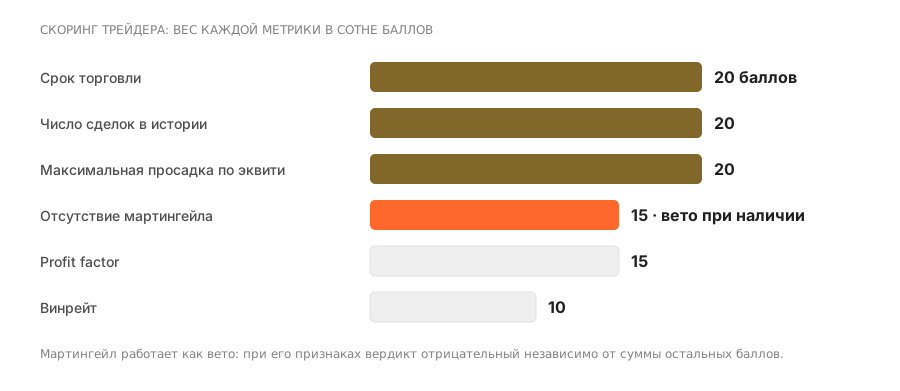
Transfer six values from the candidate's card. The score is recalculated immediately, and the table beneath it shows where each term came from.
| Criterion | Points | What it means |
|---|
Profit factor is shown as a whole number ×100: a value of 140 means 1.40 — for every dollar of loss there are 1.40 dollars of profit. The score covers four of eight filters: the shape of the curve, behaviour in stress periods, the full subscription cost and the test period are computed by hand.
How the scoring works: six terms and three gates
The sum of points is only half the model. The other half is the conditions that cap the result from above no matter how much has been scored.
| Criterion | Maximum | What earns full marks |
|---|---|---|
| Track record length | 25 | from 24 months: the history has been through different market regimes |
| Maximum drawdown | 25 | up to 15 %: the drawdown is reproducible by a subscriber |
| Profit factor | 20 | from 1.60: there is a safety margin for costs |
| Number of trades | 15 | from 300: the sample is statistically meaningful |
| Verification of the statistics | 10 | the account is verified independently, not by a screenshot |
| Own money in the account | 5 | the lead trader risks alongside subscribers |
Less than six months of trading or fewer than fifty trades. Any total on such a sample means a lucky quarter rather than a strategy: the verdict does not rise above “watch”.
the sampleA profit factor below 1.15 or a drawdown above 40 %. In the first case profit almost equals loss and costs eat it whole; in the second the subscriber will not sit through to the recovery.
rejectSigns of size doubling after a loss zero out the result whatever the other metrics say. Martingale does not spoil the figures, it improves them: it lifts profit factor, hides drawdown and adds trades.
an unconditional noUp to 40 points — reject; 40–60 — watch without money; 60–80 — a candidate for a test subscription at minimum size; above 80 — a rarity that usually means missing information rather than a perfect lead trader.
the verdictA trader vetting checklist: what scoring does not replace
The model covers four filters out of eight — the ones computed from the numbers in the card. The remaining four take eyes and time, and it is those that eliminate most high-scoring candidates.
The order of use. Scoring comes third: first you work out the size you will be able to copy at, then the full annual subscription cost, and only then screen the candidate. Otherwise it is easy to find an excellent lead trader your deposit cannot carry.
Frequently asked questions
How many points are enough to subscribe?
From 60 — and only for a test subscription at minimum size. The score does not replace the test period: it shows that a candidate is worth checking, not that they are worth copying at working size.
Why does a trader with perfect metrics get a low verdict?
Most likely the martingale gate fired. A profile with a 9 % drawdown, a profit factor of 1.90 and six hundred trades is the classic portrait of doubling size after a loss: it improves every metric while moving the risk into one future day.
What counts as verified statistics?
Confirmation of the result by a party with no interest in dressing it up: investor access to the account, an export from an analytics service, the platform's own statistics tied to the trading account. Terminal screenshots and images in a messenger are not verification.
How much does it matter that the lead trader has their own money in the account?
It is five points out of a hundred — a signal, not a guarantee. Own funds align interests but do not protect against a bad strategy: the lead trader can lose their money along with yours.
How do you assess a trader before copying?
Across six figures: track record, number of trades, maximum drawdown by equity, profit factor, win rate and the presence of martingale. The first two decide whether the rest mean anything.
How long should a trader have been trading?
At least a year, and better two — so that the history contains at least one period awkward for their strategy. Three good months are indistinguishable from luck.
How do you tell whether a trader uses martingale?
From the trade history: size grows after a loss rather than staying constant. Indirect signs are a very high win rate with rare large losses and a suspiciously smooth equity curve.
Which matters more — return or drawdown?
Drawdown. Return tells you how much they earned; drawdown tells you whether you will survive the road to that earning. Accounts are closed because of the second, not the first.
Is a trader with a high win rate worth copying?
A high win rate on its own means nothing: it is easily achieved by not closing losing positions. It must be read only alongside the average size of wins and losses.
What comes after scoring?
A test period on a small share of the deposit. Scoring filters out the obviously unsuitable, but only real trading can confirm that a strategy is compatible with your account.
Read next
