About the project: who runs ACTF and on what money
The project explains forex copy trading through arithmetic: how much is left for the subscriber after spread, swap and the lead trader's fee. Here is who does it, under what rules, and how the project earns.
What we publish
Who writes the material

We convert spread, swap, slippage and the lead trader's fee into pips and money for a specific deposit. The formulas are open in the methodology and reproduced in the table.
our core competenceLicence, jurisdiction, fee model and account types are checked on the platform's site and in regulators' registers, not in other people's reviews.
before publicationConnecting signals, copy settings and order behaviour are checked in the terminal rather than paraphrased from a platform's help pages.
hands-onA real person's byline only means something when verifiable experience stands behind it: a public trading record, a certification or a professional biography the reader can confirm. Inventing such a person for a site about other people's money would deceive the reader at the most sensitive point of all. That is why the author is the editorial team, and we say so plainly. When a subject-matter expert with a verifiable record joins the project, their name and area of responsibility will appear here and in the bylines.
How the project earns
Some links to platforms are affiliate links: if you open an account through one, the platform pays the project a fee. This affects neither what we publish nor our conclusions: we have no paid slots in our round-ups and no agreements about a "positive tone". Details are in the affiliate link disclosure.
We take no money for reviews, run no platform banners and do not sell our subscriber list.
Frequently asked questions
Are you connected to any platform or broker?
We do not belong to a broker and receive no payment for particular conclusions, but there is one connection that has to be named: the same team develops the Allocation platform. The material about it is marked as a description of our own product rather than an independent review. Other partner relationships are limited to referral links and are disclosed separately.
Why are there no scores and stars?
A score only means something alongside a published scoring method. Until that method is set out criterion by criterion, stars are decoration that misleads the reader.
May we use your calculations in our own material?
Yes, with a link to the source page. The formulas and illustrative assumptions are described in the methodology — when quoting, state that the figures are illustrative.
Who writes the site's material?
The project's editorial team. Articles are not signed with individual names, because every text goes through calculation and a check by a second person — responsibility here is editorial rather than personal.
How does the project earn?
Some links to platforms are affiliate links. That affects neither our assessment, nor the order in the catalogue, nor the price for the reader — details are on the affiliate links page.
Do you give personal recommendations?
No. Advice to "copy this trader" would be personal investment advice. We explain the selection method; the decision stays with the reader.
How often is material updated?
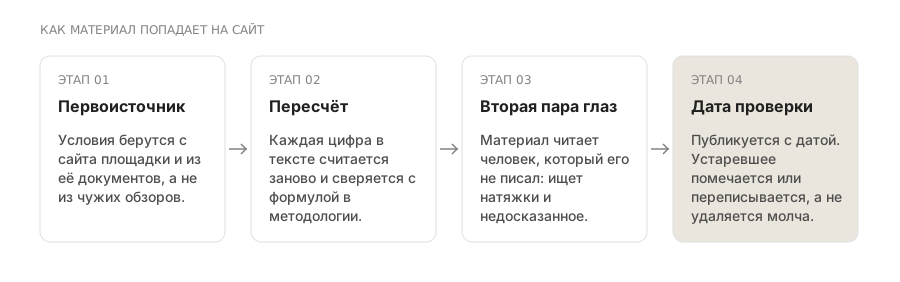
Platform terms are checked as they change, and the verification date is shown on every page. Outdated material is rewritten or flagged, not removed without trace.
Why are there no scores in your reviews?
Because a single score glues together things that are not comparable: convenience, costs and the legal framework. Instead of a score we write who a platform suits and who it does not.
Read next