Leverage and margin when copying trades
Your leverage in copy trading may differ from the leader's — and then the very same trade demands several times more free funds from you. We look at how margin is calculated, why a subscriber gets stopped out before the leader and what leverage to set.
Leverage sets the collateral; size sets the risk
Leverage does not increase risk by itself — risk is set by position size. Leverage determines how much money the broker locks up against a position: at 1:100, 0.10 lots of EURUSD needs about 100 units of base currency as margin, at 1:30 about 333. That governs how many trades you can hold at once.
A key misunderstanding. Copying does not transfer the lead trader's leverage to your account. It transfers size. If the lead trader has 1:500 and you have 1:30, then at the same size your margin will be several times larger — and there may not be enough free funds for the next trades.
Margin in copy trading: what a position requires
Calculated for EURUSD at around 1.10. The figures are rounded and given for a standard account — your broker's numbers may differ, but the order of magnitude is the same.
| Leverage | 0.01 lots | 0.10 lots | 1.00 lot | Free funds needed for 10 trades of 0.10 |
|---|---|---|---|---|
| 1:500 | $2 | $22 | $220 | $220 |
| 1:200 | $6 | $55 | $550 | $550 |
| 1:100 | $11 | $110 | $1,100 | $1,100 |
| 1:50 | $22 | $220 | $2,200 | $2,200 |
| 1:30 | $37 | $367 | $3,670 | $3,670 |
The last column shows why a subscriber on low leverage runs out of funds on a grid strategy: the leader holds a dozen positions comfortably while your account hits its margin ceiling.
What happens at different leverage
Stop-out in copy trading: why you get knocked out before the leader
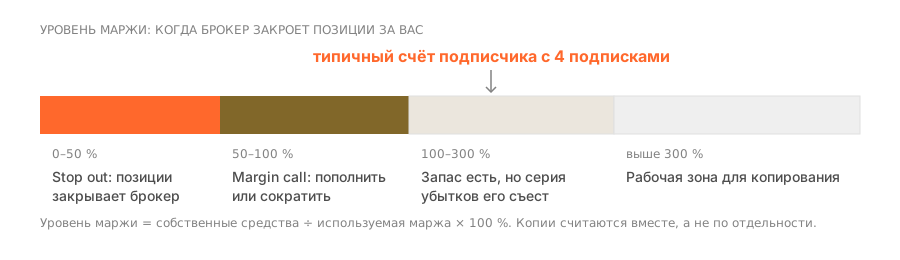
The broker force-closes positions when the margin level drops to a set threshold. Margin level is the ratio of equity to used margin: the larger the margin and the deeper the floating loss, the closer that threshold.
A smaller number on the account means nothing in itself: with proportional sizing, the same drawdown in pips consumes the same share of the deposit for you and for the lead trader. Two other factors are what undo a subscriber. The first is size rounding: if the proportion gives less than the minimum lot, the platform opens 0.01, and your risk in per cent ends up higher than the lead trader's. The second is a worse entry price caused by latency: the position is already down by the amount of slippage at the moment it opens. While the size is scaled proportionally, you travel towards a stop-out level with the lead trader; once the size is rounded up, your account gets there noticeably sooner.
The practical conclusion. Do not set the maximum available leverage "just in case", and do not copy grid strategies on an account with low leverage. The first tempts you into larger sizes; the second guarantees margin rejections at the worst possible moment.
Frequently asked questions
What leverage should you set for copying?
Enough that the margin for all the leader's simultaneous positions takes up no more than a third of your deposit. For most medium-term strategies that means 1:100; grid strategies need more, but those are best not copied at all.
Does leverage affect the size of the loss?
No. The loss is determined by the trade size and the distance to the stop. Leverage affects how much money is locked up and how quickly you hit a margin call with several positions open.
What is deposit exposure?
The share of funds tied up as margin for open positions. In a trader card this figure is often shown separately: high utilisation at the lead trader means your account will need a large reserve of free funds.
Can leverage be changed after the account is opened?
At most brokers yes, in the account area, but usually only with no positions open. Changing leverage during an active subscription is a bad idea: the margin required on already-open trades changes.
What is margin level and how is it calculated?
Own funds divided by used margin, multiplied by one hundred per cent. Below 100 % a margin call arrives; below the broker's threshold positions are closed forcibly.
What leverage is safe for copying?
Leverage itself is not dangerous — what is dangerous is the size you allow yourself under it. High leverage has one practical meaning: it lets you open a position that, at sensible risk, you should not have opened.
What happens at a stop-out?
The broker closes positions forcibly, starting with the most loss-making, until the margin level returns to an acceptable value. Copies are closed along with everything else, regardless of the lead trader's plans.
How is margin calculated across several subscriptions?
For the whole account together, not per subscription. Four strategies, each of which looks moderate on its own, can exhaust free funds between them.
What are free funds?
The difference between equity and used margin — what the account has to survive a move against the position. It is this reserve, not the balance, that determines whether you live to see the reversal.
Can you copy with more leverage than the lead trader?
Technically yes, in substance no: you will get their strategy at a different risk. Matching the percentage risk matters more than matching the leverage, and it is achieved through the sizing mode rather than the size of the credit line.
Read next
