What happens when a trade is copied: the order's path to your account
What happens when a trade is copied between the lead trader's entry and your order: three stages, on each of which size and price change. Put in your own figures and see what each step costs.
Stage-by-stage calculation on your figures
Set both deposits, the lead trader's lot, their stop-loss and how active the strategy is. Switch between stages — each one shows exactly what happens to the size and what it costs you personally.
Pip value and slippage are sliders rather than hard-wired constants: the defaults correspond to a standard lot of a major pair.
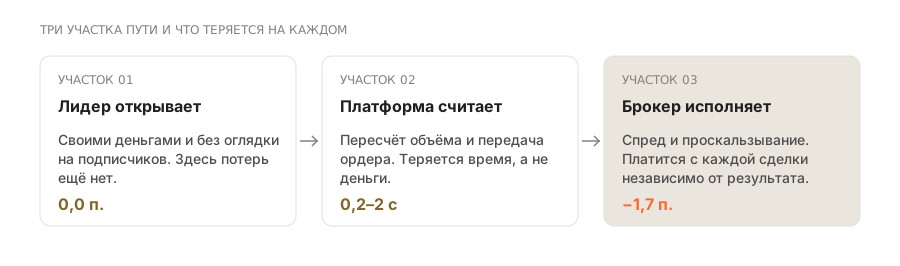
Stages of copying a trade: three sections and what changes on each
Copying looks like an instant repeat of a trade. In fact the order passes three independent sections, and on none of them do your conditions match the lead trader's.
They enter on their own account, on their own terms and with their own size. Everything visible in their card is the result of that account: without your fee, without your broker's spread and without latency.
a benchmark you will not haveThe signal reaches the copying service, the size is recalculated for your deposit and rounded to the lot step. Time is lost here — from fractions of a second on server-side solutions to seconds on terminal-based schemes.
latency and roundingYour broker closes the trade at its own price and its own spread. The gap against the lead trader's price is slippage, and in a thin market it costs more than the latency itself.
your price, not theirsEach individual gap is small, but it repeats on every trade. At forty trades a month, half a pip of difference turns into a noticeable share of the annual result.
multiplied by frequencyCopying latency and what else makes up the gap
How to test the gap in practice. For the first two or three months copy at the minimum size and, once a month, compare your return with the lead trader's showcase over the same period. A persistent divergence of more than a couple of per cent a month means the cause is not bad luck but conditions: the spread, the latency or the strategy's trade frequency.
Frequently asked questions
Why is my entry price different from the lead trader's?
Time passes between their order and yours: the signal travels to the platform, the platform places an order at your broker, the broker fills it at its own price. In liquid hours the difference is fractions of a pip; in a thin market and on news it is several pips.
What latency is considered normal?
It depends on the scheme. Server-side copying inside one platform fits into fractions of a second; copying between different brokers through a terminal takes seconds. What matters is not the figure itself but its ratio to the strategy's horizon: for scalping a second is fatal, for position trading it is invisible.
Can a trade be copied with no latency at all?
No. Even when execution happens on one server, time is still needed to recalculate the size and place the order. Latency cannot be removed — you can only choose strategies for which it does not matter.
Why is my return lower than in the lead trader's card?
The headline figure is calculated on their account: without your fee, your spread, your swap and your latency. A gap of a few percentage points a year is normal even with careful copying; a multiple gap means mismatched deposits or unsuitable trading conditions.
How long does copying a trade take?
From fractions of a second at broker-run services to several seconds where an external platform is in the chain. It matters only for strategies where the entry is decided in seconds.
What is execution latency?
The time between the lead trader's deal and yours. It is made up of signal transmission, processing at the venue and execution at the broker — no service can remove it entirely.
Why did a different size open for me?
The size is recalculated for your deposit and rounded to the broker's lot step. If the calculated value is below the minimum lot, it is rounded up — and the risk ends up above the original.
Can a trade fail to open at all?
It can: there were not enough free funds, the instrument is missing at your broker, a cap on the number of positions triggered, or the market was closed. The reason is usually visible in the service's log.
Is the closing of a trade copied?
Yes, the exit is broadcast just as the entry is, and with the same latency. That is exactly why manual interference in a copied position damages the strategy most of all.
How do you check execution quality?
Compare your entry prices with the lead trader's across a dozen trades and work out the average gap in pips. That figure, multiplied by the number of trades in a year, is the cost of copying.
Read next
