Copy trading fees: what the subscriber actually pays for
Copy trading fees come in three payment models, and on the same inputs they produce radically different costs. Work out which is cheaper for your deposit: a subscription, a success fee or a per-volume charge.
The full cost map
| What is charged | Who takes it | When it arises | How visible |
|---|---|---|---|
| Subscription per period | Leader or platform | Monthly, regardless of the result | Visible immediately |
| Success fee on profit | Leader | On every profitable period | Visible immediately |
| Per-volume commission | Platform or leader | On every trade | Accumulates unnoticed |
| Spread | Broker | On every trade | Accumulates unnoticed |
| Swap for holding overnight | Broker | For every night a position is held | Accumulates unnoticed |
| Slippage | Market | On every entry and exit | Almost never tracked |
| Deposit and withdrawal fees | Payment provider | Whenever money moves | Visible immediately |
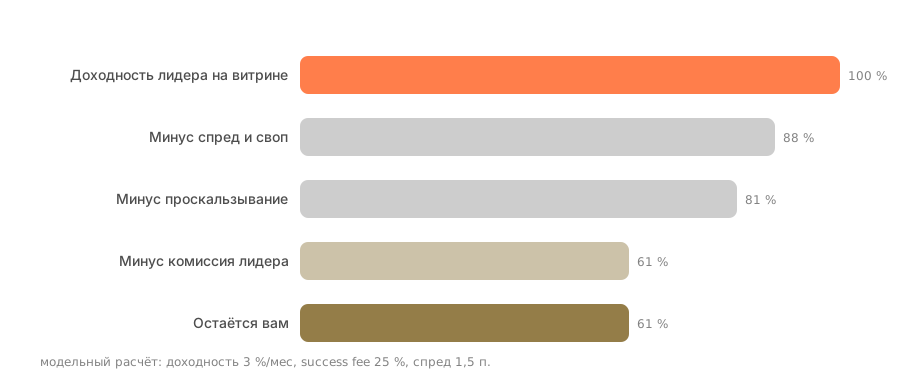
Where the leader's return goes
Of the hundred per cent shown on a showcase, about sixty reaches the subscriber — the rest is consumed by trading costs and the lead trader's fee.
What to check in the platform's terms before subscribing
The percentage rate is half the condition. The other half hides in what base it is taken from and how often. Seven points that move the final amount more than the rate itself.
| What to check | Why it changes the amount |
|---|---|
| What base the profit share is taken from | The trading account's result, or the result already net of the platform's charge. Over a year the gap between a gross and a net base is noticeable |
| Is there a high-water mark | Without it you pay a second time after a drawdown for returning to a level already reached — that is, for profit that does not exist |
| How often it is withheld | Monthly withholding on an uneven curve costs more than quarterly: profitable months are paid for, losing ones are not refunded |
| Is the per-volume charge taken on both sides | Some platforms charge on both the open and the close. For an active strategy that doubles the main expense line |
| What happens on early disconnection | Whether a share is taken from unrealised profit and whether part of the subscription is refunded for the unused period |
| Who pays for the spread | If copying runs through a partner broker, the spread may be wider than the market — that is a hidden part of the fee |
| Can the terms be changed unilaterally | A rate raised after you connected turns the subscription economics you calculated in advance into different economics |
If the platform will not answer the first three points before you subscribe, there is no need to read further: those are what determine how much you pay at one and the same stated percentage.
The cost of subscribing to a trader in different scenarios
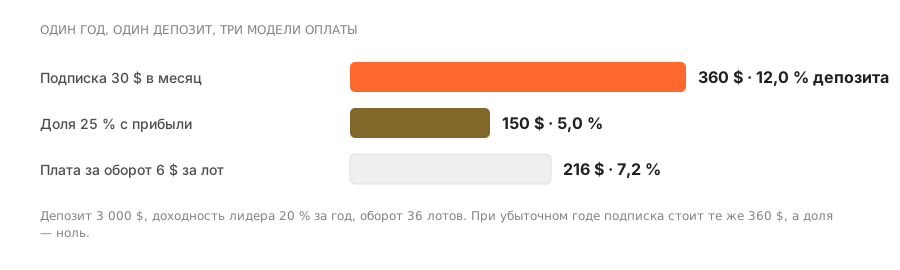
The same payment model can be the cheapest or the most expensive — it all comes down to deposit size, how active the strategy is and the year's result.
A fee on profit is not charged at all — that is its key advantage. A subscription and a per-volume charge are taken in full and deepen the loss.
up to 100 % difference in costsA fixed $50 a month on a $1,000 deposit is 60 % a year in fees alone. The model only makes sense from several thousand dollars up.
break-even thresholdA scalper turns over hundreds of lots: the per-volume charge and the spread become the main expense, and a success fee looks better value.
depends on turnoverWithout that principle the leader gets paid twice for recovering from a drawdown — for profit you do not actually have.
check the termsCompute the full cost, not the quoted percentage. "20 % of profit" sounds more modest than "50 $ a month", but at a return of 2.5 % a month on a deposit of 10,000 $ they are the same thing. The only correct way to compare is to reduce everything to a yearly sum, as the calculator above does.
Frequently asked questions
What is a success fee and when is it charged?
It is the share of profit the lead trader takes. It is charged at the end of a settlement period and only on new account highs, if the platform applies a high-water mark. In a losing period it is not charged at all — that is its main difference from a subscription.
Why do the quoted percentage and the real costs diverge?
Because the percentage covers only the lead trader's fee. Added to it are your broker's spread and swap, the platform's turnover commission and the slippage of copying. Together they are often comparable to the lead trader's fee itself.
What is cheaper on a small deposit?
A share of profit. A flat subscription does not depend on account size, so on a thousand dollars fifty dollars a month turns into sixty per cent a year before the first trade.
Is a fee refunded if the lead trader goes into loss?
No. A fee already charged is not returned, and a subscription for a paid period is not usually recalculated either. That is exactly why, in a losing year, the flat-fee model costs the most.
What is charged for forex copy trading?
A share of profit is usually 10–30 %, a subscription is a flat monthly amount, and a turnover charge applies per copied lot. The model is set by the lead trader or the platform and is visible before you subscribe.
Which is dearer — a share of profit or a subscription?
On a small deposit, almost always the subscription; on a large one, the share of profit. The break-even point is where the annual subscription equals the share of expected profit for the same year.
Is the fee charged automatically?
Yes, the platform debits it from the account under its own rules: a share of profit at the end of a settlement period, a subscription on the renewal date. No separate action is usually required from you.
Is there such a thing as free copy trading?
The lead trader's fee can be free, but copying as a whole cannot: spread, swap and slippage remain in every case. "No commission" on a showcase means one of four cost items is absent.
What is a fee settlement period?
The interval over which profit is measured and the share is charged: a week, a month or a quarter. The shorter it is, the more often you pay for swings that the next period may give back.
Can a rate be negotiated with the lead trader?
At venues with standard terms, no — the author sets one rate for all subscribers at once. Private arrangements move the relationship outside the service and strip you of its protective rules.
Read next
