Spread and swap when copying trades: the real cost
Spread and swap in copy trading, plus slippage, are the three subscriber costs missing from the leader's advertised return. They are charged on every trade regardless of the outcome.
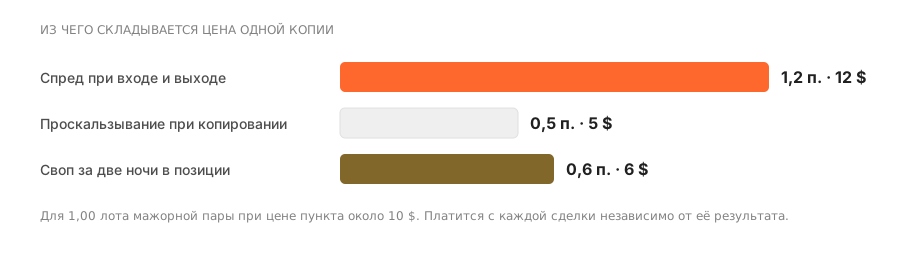
Three costs the advertised return leaves out
The lead trader trades at their broker and you at yours. Spread, swap and slippage on your side are computed under your terms and never enter the provider's statistics at all. It is a standing tax on copying: it does not depend on whether the trade turned out profitable or not.
Slippage in copy trading and the other sources of divergence
What it costs in money
Calculated for 0.10 lots of EURUSD: a pip value of about $1 and swap taken as 1 pip per night. Scale it to your own size — the relationship is linear.
| Strategy style | Trades per month | Cost per trade | Monthly total | To break even you need |
|---|---|---|---|---|
| Scalping | 200 | 1.5 pips of spread + 0.7 slippage | $440 | more than 2.2 pips of profit per trade |
| Intraday | 60 | 1.5 pips of spread + 0.5 slippage | $120 | about 2 pips per trade |
| Medium-term | 15 | 1.5 pips + 0.5 + 3 nights of swap | $75 | about 5 pips per trade |
| Position trading | 4 | 1.5 pips + 0.5 + 10 nights of swap | $48 | about 12 pips per trade |
The conclusion is counter-intuitive: in absolute money scalping costs the most, but per trade it is position strategies that suffer worst — because of swap over long holding periods.
What can be reduced and what cannot
| Cost | Can it be reduced | How |
|---|---|---|
| Spread | Yes | A tight-spread account with commission instead of a standard one; compare the combined cost |
| Turnover commission | Partly | The broker's tariff plan, though at high turnover it still matters |
| Swap | Partly | A broker with better rates; avoiding strategies that hold positions for long stretches |
| Slippage | Yes | A VPS closer to the broker's server, and server-side copying instead of local |
| Gap risk | No | The weekly open and news releases — a risk the subscriber carries |
Frequently asked questions
Why is my result worse than the leader's when the trades are the same?
Four things add up: a wider spread at your broker, slippage on entry and exit, swap at your rates and the platform fee. Each is small on its own; together they take a noticeable share of the profit.
Is an ECN account better for copying?
Usually yes for active strategies: a tight spread plus a fixed commission beats a wide spread when trade counts are high. For infrequent trades the difference is barely noticeable — do the maths on your own turnover.
What is triple swap?
Mid-week brokers charge three days of swap at once to cover the weekend. For strategies that hold positions through Wednesday this is a noticeable expense.
Can slippage be seen in a report?
Not directly, but indirectly yes: compare your trade's opening price with the leader's across several entries. The difference in pips is your average slippage.
How does the spread affect copy trading?
It is deducted from every trade at entry and exit, so the more often the lead trader trades, the more you give up. For a scalper the spread can exceed the lead trader's fee.
What is a swap and when is it charged?
A charge for carrying a position overnight, applied at midnight by the trading server's time. From Wednesday to Thursday a triple swap is usually charged to cover the coming weekend.
How do you reduce costs when copying?
Choose a broker with a tight spread on the instruments you need, copy a lead trader who works in liquid hours, and do not increase size with a multiplier. Costs are never removed entirely.
What is slippage and why is it larger in copying?
It is the difference between the expected and the actual fill price. In copying, time passes between the lead trader's deal and yours, during which the price moves — hence the gap.
Is an ECN account better for copying?
Often yes: a tight spread plus an explicit commission is usually cheaper than a wide spread, especially on frequent trades. The sum is what matters, because the ECN commission is charged separately.
Does lot size affect the spread in pips?
In pips, no; in money, yes, in proportion to size. That is why a ×2 multiplier doubles not only the trade's result but the cost of entering it.
Read next
