Copy modes: automatic, manual, semi-automatic
Trade copying modes differ in how much control you keep for yourself: the same lead trader produces three different outcomes. Switch the mode and compare automatic, manual and semi-automatic copying by speed and effort.
Automatic, manual and semi-automatic trade copying
Switch the mode and the summary above shows what you pay for speed or for control.
Automatic mode
The leader's trade opens on your account without you — you find out from the terminal or a notification. This is the default mode for MT4 and MT5 signals and for every broker service.
Who it suits: those copying a proven lead trader with a clear strategy who have set hard loss limits
Manual mode
The platform or channel sends a signal, but you place the order in the terminal yourself. Strictly speaking this is a signal subscription rather than copying.
Who it suits: those who are learning and want to understand the logic of every trade, and medium-term strategies where minutes do not matter
Semi-automatic mode
Trades are copied automatically but under your rules: instrument filters, size caps, a ban on trading at certain hours, confirmation for large positions.
Who it suits: most subscribers with a deposit they would hate to lose: a working compromise between speed and control
A comparison across six parameters
| Parameter | Automatic | Manual | Semi-automatic |
|---|---|---|---|
| Entry latency | 0.2–2 s | minutes | 0.2–2 s |
| Control over the trade | none | full | within set rules |
| Effort | minutes a week | daily presence | hours to configure, then very little |
| Match with the leader | maximum | low | partial |
| Risk of subscriber error | low | high | medium |
| Suitable for scalping | yes | none | yes, with caveats |
A common mistake. Manual mode is chosen out of caution and delivers the worst outcome: profitable trades missed while the losing ones are executed in full. If you are not prepared to follow signals with discipline, automatic mode with a hard loss limit is safer.
How the mode affects your risk
The copying mode determines not convenience but whether your risk matches the lead trader's. The difference between modes is measured in per cent of the deposit, not in clicks.
The size is recalculated by the ratio of your deposits, so the share of the account at risk is the same for you as for the lead trader. It is the only mode in which the strategy works as its author intended.
The same size on accounts of different sizes is a different percentage of risk. On a small deposit a fixed lot turns a moderate strategy into an aggressive one; on a large deposit into an almost idle one.
Copying with a coefficient moves both return and drawdown in the same direction. A multiplier below one makes sense during a test period; above one it is a bet that past results will repeat.
Frequently asked questions
Which copying mode should a beginner choose?
Proportional: the size is recalculated for your deposit, and the risk in per cent repeats the lead trader's. It is the only mode in which the strategy works as its author intended. A fixed lot and a multiplier make sense later, once you have seen this strategy's drawdown with your own eyes.
How does automatic copying differ from signals?
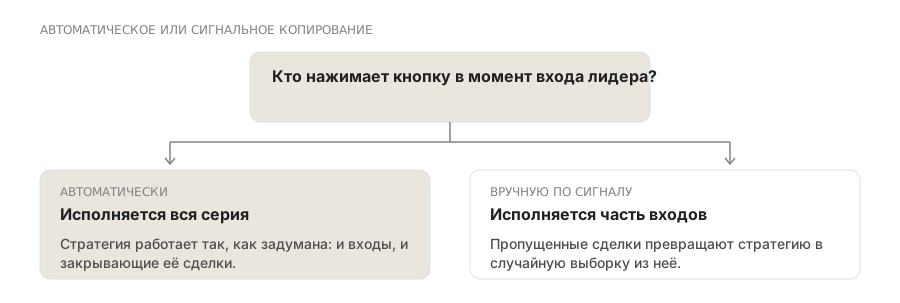
By where responsibility sits. In automatic mode the trade executes without your involvement; in signal mode you get a notification and decide yourself. The second looks safer, but in practice a person misses some entries and ends up with a random sample of the lead trader's strategy rather than the strategy itself.
Can several traders be copied at once?
Technically yes, and most venues allow it. The problem is that several subscriptions become a portfolio only at low correlation: five lead traders on one currency group deliver the risk of a single position at five times the size.
What happens to open trades when copying is switched off?
It depends on the venue: some close positions immediately, others leave them with you and simply stop broadcasting new ones. The second is more dangerous — you are left holding someone else's positions with no exit plan, so the switch-off procedure is worth establishing before you subscribe.
What is proportional copying?
A mode in which your trade size relates to the lead trader's as your deposit relates to theirs. The result: your risk per trade in per cent matches theirs.
How do you copy at a reduced size?
With a multiplier below one, or with proportional mode on a smaller deposit. Both reduce return and drawdown in the same proportion — there is no free reduction of risk here.
What is partial copying?
Copying not all of a lead trader's trades but a selection: by instrument, by size or by time. It works only if you understand the logic of their sequences; otherwise you get a filter without a strategy.
Can you copy only the profitable trades?
No. Profitability is known only after a trade closes, and copying happens at the moment it opens. Any promise of such filtering is either a misunderstanding or a deception.
Should the lead trader's stop-losses be repeated?
If the service can do it, yes: a stop is part of the strategy, not a decoration. Your own tighter stop will knock you out of trades the lead trader would have closed in profit, turning their strategy into a different one.
Does the copying mode affect fees?
On the lead trader's fee, usually not; on trading costs, yes: the larger the size, the larger the spread and swap in money. A ×2 multiplier doubles not only the result but the costs.
Read next
