Copy trading glossary
A copy trading glossary: 42 terms you will meet in platform interfaces and trader cards. Start typing and the list filters itself.
Key terms: lead trader, master and slave accounts, high-water mark
Terms shown: 42 of 42
| Term | Meaning |
|---|---|
| High-water mark | The principle that a fee is charged only on new account highs, not a second time for recovering from a drawdown. |
| MAM and LAMM | Managed-account schemes where trades are allocated across clients' individual accounts. |
| Profit factor | The ratio of total profit to total loss. Below 1.1 there is no margin of safety. |
| Recovery factor | Net profit divided by maximum drawdown. Shows whether a strategy pays for the risk it takes. |
| Success fee | The leader's fee as a percentage of your profit. |
| VPS | A virtual server that keeps the terminal running around the clock without your computer. |
| Auto-following | A regulated brokerage service that repeats trades on an exchange account. |
| Win rate | The share of winning trades. Meaningless without the reward-to-risk ratio. |
| Showcase | A platform's public trader ranking. Usually sorted by return, which makes it a poor screening filter. |
| Diversification | Spreading capital across several uncorrelated strategies. |
| Discretionary managed account | Handing funds to a manager under a contract, with legal protection and an entry threshold. |
| Copy latency | The time between the leader's trade and the subscriber's trade opening. It directly drives the divergence in results. |
| Mirror trading | Copying a formalised strategy rather than a specific person. Historically the predecessor of copy trading. |
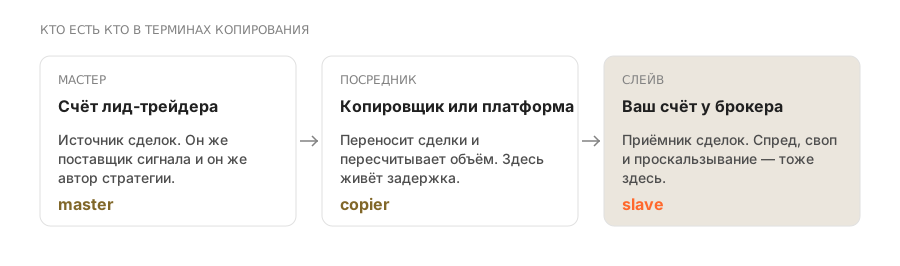
| A trade copier | A program that transfers trades between accounts, either locally or server-side. |
| Copy trader | The subscriber on whose account trades are repeated. Also: follower. |
| Copy trading | Automatic repetition of a chosen trader's deals on your account. Synonyms: trade copying, copy trading. |
| Strategy correlation | The degree to which two strategies produce losses at the same time. At high correlation a portfolio offers no protection. |
| Sharpe ratio | Return adjusted for volatility. It lets you compare strategies that run different levels of risk. |
| Leverage | The ratio of position size to your own funds. It amplifies both profit and loss. |
| Equity curve | A chart of account equity over time. Its shape says more about risk than its slope does. |
| Lead trader | The trader whose trades are copied. Also: master trader, signal provider, strategy provider, leader. |
| Per-subscription loss limit | The threshold at which copying stops automatically. |
| Maximum drawdown | The worst peak-to-trough fall in the account's entire history. The key screening filter. |
| Margin call | A broker's warning that free funds have reached a critical level. |
| Martingale | Increasing size after a loss to win it back. It produces a smooth curve and zeroes the account on a long streak. |
| Master account | The source account for signals in a local copying setup. |
| Copy multiplier | The coefficient by which the lead trader's position size is multiplied when transferred to your account. |
| PAMM account | A manager's pooled account in which investors hold shares and split the result proportionally. |
| Proportional copying | A mode where size is scaled by the ratio of deposits — your percentage risk equals the leader's. |
| Balance drawdown | The largest fall in the account measured on closed trades. Usually this is what the showcase displays. |
| Equity drawdown | The largest fall in the account including the floating loss on open positions. The more important figure for a subscriber. |
| Slippage | The difference between the leader's price and the price your trade actually opened at. |
| Requote | The broker's refusal to fill an order at the requested price, offering a new one instead. |
| Swap | The charge for holding a position overnight. It builds up unnoticed on medium-term strategies. |
| Order grid | A set of pending orders placed at equal intervals. Often accompanied by averaging into losses. |
| Slave account | The receiving account where the master's trades are repeated. |
| Reward-to-risk ratio | The average winning trade divided by the average losing trade. Written as RR or R:R. |
| Social trading | A format where you see traders' feeds and ideas but execute the trades yourself. |
| Spread | The difference between the buy and sell price. A constant cost on every trade. |
| Stop-out | The broker force-closing positions when margin runs out. |
| Averaging into a loss | Adding to a position against the price move in the hope of a reversal. |
| A fixed lot | A mode where every trade opens at the same size regardless of the leader's size. |
Terms most often misunderstood
Four words from subscription terms where the everyday meaning diverges from what the venue's contract says.
In platform terms this word appears only in marketing. Legally, neither copying, nor a PAMM, nor managed accounts can guarantee a return — a phrase about a guarantee is in itself a reason not to sign up.
It means only that the figures are computed from a connected trading account rather than entered by hand. That is protection against a drawn return, not an assessment of the strategy's quality.
Drawdown by balance and drawdown by equity are different figures. The first counts only closed trades and therefore always looks gentler; traders should be compared by equity.
In Russia this is a regulated service of an exchange broker rather than a synonym for copy trading. The word in a forex venue's advertising most often means ordinary copying with no legal framework.
Frequently asked questions
How does a lead trader differ from a signal provider?
In substance, not at all — it is the same person under different platform labels. The difference is in the model: a signal provider usually charges a subscription per period, a lead trader more often a share of profit.
What are master and slave accounts?
The master is the account trades are broadcast from; the slave is the account they are copied to. The terms come from local MetaTrader copiers, where both sides are two terminals on one machine or one VPS.
What does high-water mark mean in subscription terms?
The rule under which a fee on profit is taken only on new account highs. Without it, after a drawdown you pay a second time to get back to a level already reached.
How does averaging down differ from martingale?
Averaging down is adding size to an open losing position; martingale is increasing the size of the next trade after a closed loss. Both raise risk non-linearly, but they break an account in different ways.
What is equity and how does it differ from balance?
Balance is the money from closed trades; equity is the balance plus the result of open ones. Drawdown by equity is always more honest: it sees a loss that has not yet been realised.
What does "leverage" mean in account terms?
The ratio of position size to the margin posted. Leverage of 1:100 means a position of 100,000 requires 1,000 of margin. Leverage by itself does not increase a loss — what increases it is the size you allow yourself under that leverage.
What are drawdown and maximum drawdown?
Drawdown is the account's current fall from its achieved peak; maximum drawdown is the deepest such fall across the whole history. The second is the figure to compare between traders.
What does profit factor mean?
The sum of all profits divided by the sum of all losses. A value of 1.0 is break-even trading before costs. The indicator is easily improved by increasing size after a loss, so on its own it proves nothing.
What are stop out and margin call?
A margin call is the broker's warning that free funds are short; a stop out is the forced closing of positions if the margin level falls further. In copying both are computed across all subscriptions together.
What is slippage?
The difference between the price at which an order should have filled and the price at which it did. In copying it is larger than in trading yourself, because time passes between the decision and the execution.
Read next
