Copy trading risks: scenarios and a drawdown simulator
The main risks in copy trading are not fraud but an ordinary losing run at too large a size. Work through six scenarios for losing a deposit while copying, and run the strategy through the drawdown simulator.
Losing your deposit while copying: six scenarios
Pick a scenario and the panel on the right breaks it down: how fast it arrives, whose fault it is, the warning signs and what to do about it.
Too much size
The commonest way to lose a deposit is neither fraud nor a bad lead trader but the wrong trade size. Your deposit is smaller than theirs, the size is rounded up, and a losing run that is normal for the strategy takes out the account.
Signs before subscribing:
- the lead trader's typical lot, scaled to your deposit, falls below 0.02
- the platform offers the minimum lot where the proportion gives less
- the calculated risk per trade exceeds 2 % of the deposit
What to do: compute the size before subscribing and reduce the multiplier, rather than hoping there will be no losing run.
It takes a minute to check in the size calculator: if a run of ten losses eats more than a quarter of the deposit, the size is wrong.
Work out size and riskMartingale beneath a smooth curve
The lead trader does not take losses but adds size against the move. The equity curve looks perfect — not a single setback — until the run arrives that the account cannot withstand.
Signs in the statistics:
- a smooth rising curve with no drawdowns alongside a high return
- drawdown by equity twice the balance drawdown or more
- trade sizes grow after losing entries
- dozens of positions open simultaneously on one instrument
What to do: reject the candidate rather than reducing the size — the risk here is not proportional to trade size.
Such accounts stay at the top of rankings for years: the showcase sorts by return, and the wipe-out happens once.
How to spot martingale in the metricsA subscription with no loss limit
Copying is configured once and runs without a safety catch. When the lead trader changes style or enters a prolonged drawdown, the account follows them to the end — and you find out from a statement.
What must be in place before the first trade:
- a loss limit for the specific subscription
- an overall account drawdown threshold across all subscriptions
- a cap on the number of positions open at once
What to do: set the limits in the settings rather than keeping them in your head — a decision taken at the bottom of a drawdown is almost always worse than one taken with a cool head.
A loss limit is the only protection that works at night and on holiday.
Settings and limitsSubscribing after the best month
The subscription is taken out at the end of a strong stretch of the curve: that is exactly when a trader reaches the top of the showcase and gathers subscribers. Statistically, a reversion to the mean follows — and the first month of copying turns out to be a losing one.
Signs:
- all the account's profit was made in one or two months, with the rest sideways
- the trader climbed the ranking recently
- the subscriber count jumped
What to do: look at the average monthly result across the whole history rather than the last quarter, and start at the minimum size.
This is not a deception: it is how any sorting by recent return behaves.
The selection methodFees larger than the return
The subscription runs without losses but brings no money either. A success fee is charged on every profitable period, spread and swap are taken on every trade, and losing months you carry in full.
When this is guaranteed to happen:
- a flat subscription on a small deposit
- an active, high-turnover strategy under a per-lot charge
- the lead trader's return below 2 % a month with a success fee of 25 % or more
What to do: compute the full annual cost before subscribing and compare the models against each other.
Costs are the only part of the result that can be computed in advance and exactly.
Compare fee modelsProblems on the platform's side
A risk that depends neither on the lead trader nor on your settings: a change of terms, a delayed withdrawal, an account block, or the service leaving the market or your jurisdiction.
What to check before funding:
- who owns the service and which regulator licenses it
- whether the venue works with residents of your country
- by what means and in what timeframe funds are withdrawn
- what recent reviews say about withdrawals, rather than reviews from all time
What to do: keep no more on the account than you are prepared to lose entirely, and withdraw profit regularly.
The one risk of the six that is removed by choosing a venue rather than by settings.
Comparing venuesA run of losing trades: why one strategy gives different outcomes
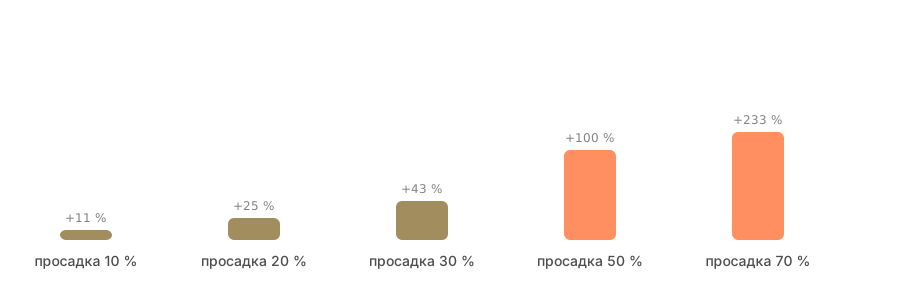
The six scenarios above describe what can go wrong. The next question is quantitative: how deep the account sinks at your risk and how often that happens over a distance.
What to do when the drawdown is already under way
The scenarios above describe how people end up in a drawdown. This is about what they do with it, because that is the step where more is lost than to the drawdown itself.
The most expensive reaction: the loss is locked in at the worst point, and the recovery the strategy holds risk for happens without you. As long as the limit has not been breached, the decision was made in advance — and changing it mid-drawdown is not the move.
the decision is made before, not duringTopping up capital in a drawdown looks like reducing the percentage loss, but it actually increases the sum under the same risk. If the strategy has broken, you are simply giving it more money.
raises the stake, not the oddsCompare the current depth with the maximum from the card. While it stays inside the familiar range, what is happening is part of the strategy, not a breakdown. Going one and a half times beyond it is the very signal the limit was set for.
compare with the lead trader's cardWhat is dangerous is not the depth but a change of handwriting: size has grown, new instruments have appeared, stops have vanished, trades are being held longer. That is a sign the lead trader is trying to win it back — and the drawdown has stopped being statistical.
more important than the figure itselfOne rule instead of a long plan. While the drawdown behaves as it has before, you do nothing. The moment it goes beyond its historical bounds or the lead trader's manner of trading changes, you switch off, regardless of how much has already been lost. Both halves of the rule are decided in advance and written down; otherwise you will be deciding at the moment when deciding is hardest.
Frequently asked questions
Can you go further into the red than your deposit?
On an unleveraged account, no. With leverage a negative balance is theoretically possible on a price gap, but most brokers apply protection against it. In practice the risk is a deposit reduced to zero, not a debt.
What if the leader blew up their account?
Nothing can be recovered: you traded on your own account and made the decision to subscribe yourself. That is precisely why a loss limit is set before copying starts, not after.
Does diversification really reduce risk?
Only when the strategies are weakly correlated. Five leaders trading the same pair in the same direction are not a portfolio but one position at five times the size.
Which scenario is the most common?
Too much size. It needs neither a fraudster nor a bad strategy — copying a large trader with a small deposit is enough.
What is the main risk in copy trading?
Not a technical failure and not platform fraud, but a mismatch between the lead trader's strategy and the size of your deposit. That is what turns their moderate drawdown into your critical one.
How do you limit losses when copying?
With three things: the share of the deposit in any one subscription, a loss limit in the service's settings where one exists, and a boundary set in advance at which you switch off. The third works only if it is decided before you subscribe, not in the middle of a drawdown.
Can a platform disappear with the money?
In copying, your money sits on your account at a broker rather than at the platform, so its departure means losing the broadcast, not the deposit. The risk of money disappearing is tied to the broker and its licence, not to the copying service.
Why is my drawdown deeper than the lead trader's?
Three causes add up: the minimum lot rounds the size upward, your costs are deducted from every trade, and your entry happens at a worse price. On strategies with frequent trades the difference is especially visible.
What is correlation risk in plain words?
It is when several of your subscriptions lose money at the same moment on the same market move. Formally you hold four strategies; in fact you hold one position at four times the size.
Is it worth copying during high volatility?
Volatility on its own is an argument neither for nor against: it increases both profit and loss. What matters is whether the lead trader's strategy is built for that regime — and that is visible only from its behaviour in past stress periods.
Read next
