What is copy trading and how it works
Copy trading explained in plain words: it is not an "investment in a trader" and not managed accounts. We walk through how forex copy trading works step by step — who does what, where the money stays and why your result does not match the lead trader's showcase.
Definition: who controls what
Copy trading is the automatic repetition of a chosen trader's deals on your own trading account. The lead trader trades their own money, the platform broadcasts every action to subscribers, and the same trade opens on your account — but at your own size, recalculated for your deposit.
What copy trading does not solve. It removes the need to find entries yourself, but not the responsibility for choosing the lead trader, sizing the risk and deciding when to exit. The lead trader's loss becomes your loss in full — and often more, because of latency and fees.
How copy trading works: eight stages
From the leader's decision to the trade on your account usually takes anywhere from a fraction of a second to a couple of seconds: faster inside a broker, slower through a third-party platform. Eight things happen in that window, and only two of them depend on you.
On their own account, at their own size, following their own strategy. They do not know who is copying them and do not adjust for subscribers.
the decision is theirsThe platform's server receives the order data: instrument, direction, size, levels. Latency starts counting from this moment.
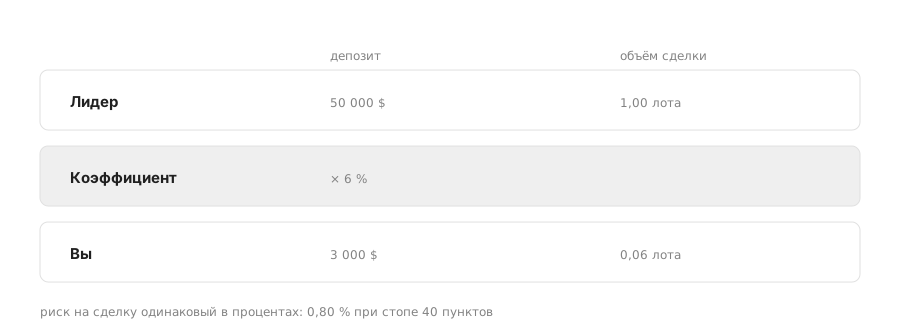
fractions of a secondThe size is scaled to your deposit: proportionally, by fixed lot or through a multiplier. Your entire risk depends on this step.
your main leverInstrument filters, a cap on the number of positions and a loss limit are applied. Some of the leader's trades simply never make it through.
your second leverThe platform sends the order for execution. Until this moment there is no trade on your account — only the intention to open one.
point of no returnThe trade opens at whatever price exists now, not at the lead trader's price. The gap between them is copying slippage.
the price of copyingMoving stops, partial closes and add-ons are broadcast the same way as the entry. Every action by the leader is repeated with the same latency.
all the way to the exitThe position closes, the result lands on your account, and the lead trader's fee is deducted from the profit under the platform's rules.
this is where the fee is chargedStages three and four are the only ones you control directly. It is this stage that turns someone else's strategy into a risk that is either acceptable to you or not: the settings breakdown with a calculator.
How it differs from adjacent formats
The terms are often used interchangeably. The difference lies in what exactly you copy and who physically controls the account.
| Format | What you get | Where your money sits | Main risk |
|---|---|---|---|
| Copy trading | The trades of one specific trader | On your own account | The leader changes strategy or blows up the account |
| Mirror trading | Execution of a ready-made strategy | On your own account | The strategy stops working in a new market regime |
| Social trading | Ideas that you execute yourself | On your own account | Your own execution mistake |
| PAMM account | A share in the manager's pooled account | In the manager's pool | No control over an individual trade |
| Discretionary managed account | A contract with a manager | With the manager | Legal and counterparty risk |
A detailed pair-by-pair comparison is on the comparisons page.
What copy trading gives you and what you pay for it
Five arguments for and five against — no marketing language and no scare tactics.
Who it suits and who it does not
Where it came from
The idea of repeating a strong player's trades is older than the internet — only the transmission speed has changed.
A subscription to a mailing list of recommendations. Latency was measured in days, execution was entirely manual, and there was no way to verify the author's results.
Systems appeared where the subscriber chose a formalised strategy and a server executed its trades on their account. What was copied was an algorithm, not a person.
Traders got a public page with statistics and followers. Now a specific person is copied, and the showcase ranks them by return.
Available at most brokers and at every large crypto exchange. The mechanics are the same everywhere; what differs is the fee model and the depth of the risk settings.
Frequently asked questions
Are copy trading and trade copying the same thing?
Yes, they are synonyms. You will also see “copy-trading”, “trade copying” and “mirror copying” used for the same mechanism.
Who is a lead trader?
The trader whose trades are copied. Also called a master trader, signal provider or strategy provider. Their motivation is the fee paid by the platform, which depends on the number of subscribers and their profit.
Do you have to keep your computer switched on?
It depends on the setup. With server-side copying inside a broker or exchange, no. With copying through the MetaTrader terminal, signals arrive only while the terminal is running, which is why people use a VPS.
How is copying different from a signal subscription?
You execute signals by hand and can skip or modify a trade. Copying is executed automatically: higher speed, less control.
How does copy trading work technically?
The lead trader's deal is captured by the platform, the size is recalculated for your deposit in the mode you chose, and the order is then sent to your broker. It fills at the current price — hence the difference from the lead trader's price.
Is copy trading suitable for a beginner?
As a way of not making trading decisions, yes. As a way of avoiding knowledge, no: choosing a lead trader, sizing positions and controlling costs require exactly the same concepts as trading yourself.
How does copy trading differ from social trading?
Social trading is the broader idea: a feed, discussion and watching other people's trades. Copy trading is only the automatic transfer of trades to your account, without the conversation and the likes.
How many traders can be copied at once?
Technically, as many as your margin will bear. Sensibly, as many as you can vet and whose strategies do not correlate with each other. Four subscriptions on the same pairs behave as one.
Can trades be copied on crypto and stocks?
Yes, copying exists at crypto exchanges and at stock brokers. The mechanics are the same, but the costs and rules differ: crypto futures charge more per turnover, and stocks bring dividend and corporate events.
What happens if the lead trader deletes their account?
The broadcast stops. Open positions will either close or stay on your account — and the second outcome is worse: you are left holding someone else's positions with no exit plan.
Read next
