Copy trading versus PAMM, managed accounts, robots and auto-following
Copy trading or PAMM, a managed account or a trading robot — six ways not to trade yourself. What separates them is not the return but where the money sits and who makes the decisions.
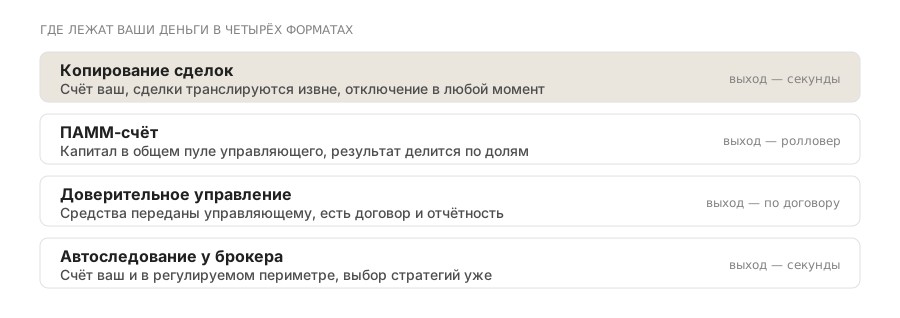
| Format | Where the money is | Control over the trade | Exiting a position | Legal protection |
|---|---|---|---|---|
| Copy trading | On your own account | Size and limit settings | Instant, at any time | Platform rules only |
| PAMM account | In the manager's pool | No | On the rollover schedule | The broker's offer terms |
| Discretionary managed account | With the manager | No | Under the contract's terms | A contract, and a regulator where licensed |
| Trading robot | On your own account | Full, down to the parameters | Instant | No — you are the operator |
| Auto-following | On a brokerage account | Choice of strategy | Instant | A regulated brokerage service |
| Funds and staking | In the product or protocol | No | Under the product's rules | A regulator, or the protocol's code |
Copy trading versus a managed account, PAMM and a robot
Pick a pair and the panel on the right breaks it down: where the money is, what happens to control and when each option wins.
Copy trading or a PAMM account
In a PAMM you buy a share in the manager's common account: the money is mixed with that of other investors and of the manager. In copying the account stays yours, and the trades are duplicated on it.
| Execution | PAMM: one trade for everyone, at the manager's price |
| Copying: a separate order for each subscriber, with its own slippage | |
| When it wins | PAMM: many small trades and a modest deposit |
| Copying: you need control, your own limits and the ability to exit at any moment |
The main difference is not in return but in rights to the account: in a PAMM you are an investor in someone else's account, in copying you own your own.
Venues offering copyingCopy trading or managed accounts
A managed account is a contract: you hand funds to a manager who uses them within an agreed strategy. With a licence you gain legal protection and a complaints procedure — which copying has none of.
- Managed accounts make sense when the amount is large enough for a management contract and the legal framework matters
- Copying makes sense when the amount is below the managed-account threshold and you need an instant exit
- Red flag: if a "lead trader" asks for access to your account or a transfer of money, that is no longer copy trading
Copying requires neither access to your account nor a transfer of funds. Any such request is a sign of a fraudulent scheme.
Scenarios for losing a depositCopy trading or a trading robot
A robot executes a formalised algorithm: it does not tire, does not panic and works around the clock — but it does not adapt. A live lead trader adapts but brings in the human factor.
- A robot breaks when the market leaves the regime its algorithm was written for: it keeps trading by the old rules until the account is gone
- A human breaks differently: chasing losses, raising risk for a place in the rankings, burning out and abandoning the account
- In both cases the protection is the same — a loss limit on your side
A robot is predictable and brittle; a human is flexible and unpredictable. The choice is which of the two risks you understand better.
Loss limitsCopy trading or trading yourself
Trading yourself is the only option in which the skill stays with you. The price is a year or two of learning and an almost guaranteed loss along the way.
- Copying delivers a result sooner but builds no competence: switch the subscription off and you are back where you started
- A sensible compromise is to copy and study the lead trader's deals in parallel: why enter here, why exit then
- Then the subscription becomes an education as well as a source of results
This is the one pairing where the choice depends not on money but on how much time you are prepared to invest.
Where to startCopy trading or regulated strategy following
Regulated following is a supervised service at an exchange broker: trades are broadcast to your brokerage account within licensed activity, with reporting and a clear tax status.
- Regulated strategy following: exchange instruments, a licence and reporting, but few strategies and higher costs
- Copy trading: a wider choice of markets and strategies and a lower threshold, but most often outside the regulated perimeter
- The criterion is not return but your willingness to operate without a legal framework
It is also a difference in tax reporting: an exchange broker acts as a withholding agent, while a foreign venue does not.
Risks and loss scenariosCopy trading or funds and staking
Regulated instruments with moderate returns against an unregulated one with high risk. Comparing them on the return percentage alone is meaningless.
- Funds: diversification inside the product, a regulator, simple reporting, market returns
- Staking: income from locking an asset, with protocol and price risk rather than someone else's trading
- Copying: income from someone else's decisions, the risk of losing the deposit in full, an exit at any moment
Copying is sensibly treated as part of a high-risk portfolio rather than as a replacement for conservative instruments.
Work out the real returnHow to choose a format for your task
The format is determined not by return but by three things: where the money sits, how quickly you can leave, and who is answerable for the result. Answer those before comparing percentages.
Then this is copy trading: the account is yours, the broadcast is someone else's, and switching off takes a second. The price of that freedom is that you carry all the management risk yourself and have no protection at all against a bad lead trader.
Then it is managed accounts or regulated following at a licensed broker. The entry threshold is higher, the choice of strategies narrower and the costs usually greater, but you gain a legal framework: a contract, reporting and someone to address a complaint to.
Then it is a PAMM: capital is combined into a common pool, the result is split by shares, and entry and exit happen at rollover points. The format is convenient at scale, but you cannot leave in the middle of a drawdown — you have to wait for the settlement period.
What all four formats have in common
The differences in rights and mechanics are real, but three things do not change in any of them — and it is those three that most often determine the outcome.
Whom to choose, how much to commit and when to stop are your decisions in every format. Neither a management contract nor a share in a PAMM pool removes the choice of manager from you.
A manager's fee, the spread, the swap and the platform's commission are present in all four formats. All that changes is what they are called and when they are charged.
A year's equity curve is a description of what has already happened. In copying, in a PAMM and in managed accounts alike it predicts the next year poorly.
Frequently asked questions
Which is safer — copy trading or PAMM?
Neither is safe, but the rights differ. With copying the money stays on your account and you can switch off in a second; in a PAMM you are an investor in someone else's pool and leave on the rollover schedule. The risk of losing capital exists in both.
How does copy trading differ from managed accounts?
In its legal structure. A managed account means a contract with a manager and a transfer of funds; copying is a technical broadcast of trades with no access to your money. Hence the different entry thresholds and the different protection in a dispute.
Copy a human or run a robot?
A robot is predictable and breaks when the market regime changes; a human adapts but acts inconsistently. The choice comes down to which failure you are prepared to live through: the algorithm's sudden one or the trader's gradual one.
Should you choose regulated strategy following over copying?
If a licence and reporting are critical for you, yes. Regulated following runs at an exchange broker inside a supervised perimeter, but the choice of strategies is narrower and the costs are usually higher. The criterion here is not return but your willingness to operate without a legal framework.
Which is better — copy trading or a PAMM account?
It depends on what matters more to you: control or simplicity. With copying the account is yours and the exit is instant; in a PAMM the capital sits in a common pool and you leave on the rollover schedule.
How does a PAMM differ from copy trading?
In a PAMM you are a co-owner of the pool and the result is split by shares; with copying the trades are repeated on your own account. Hence the difference in rights, in exit speed and in what the reporting shows.
What is regulated strategy following and how does it differ?
A regulated service from an exchange broker: strategies are broadcast inside a legal framework with a licence and reporting. The choice of strategies is narrower and the costs are usually higher, but there is someone to bring a complaint to.
Can copying and PAMM be combined?
You can, and it is wiser than choosing one: the formats behave differently under stress. But diversifying by format does not cancel correlation by instrument.
Where is the entry threshold lower?
Usually with copying inside a broker: subscriptions there start from small amounts. Closed platforms and PAMMs run by well-known managers demand noticeably more.
What should you choose with a small amount?
Copying: it is the only format that lets you start with a share you would not mind losing entirely and leave at any moment. The others either demand more or tie the money up for a term.
Read next
