Copy trading settings: size, multiplier and limits
Configuring trade copying is the one stage you control. The same strategy under different size settings delivers either acceptable risk or a stop-out on the very first losing run. Work out your own version.
Copy size: how much to set
Size is the first thing you set and the only thing that cannot be fixed after the fact: it determines both the profit and the depth of the drawdown. You do not need to compute it by hand, but it helps to know the order of magnitude before you open a calculator.
Four groups of parameters
Subscription settings fall into four independent blocks. A mistake in any one of them ruins the outcome even if the other three are set correctly.
What exactly you pay for: a fixed amount per period, a share of profit, a per-volume commission or all at once. The fee model determines the return at which a subscription even breaks even.
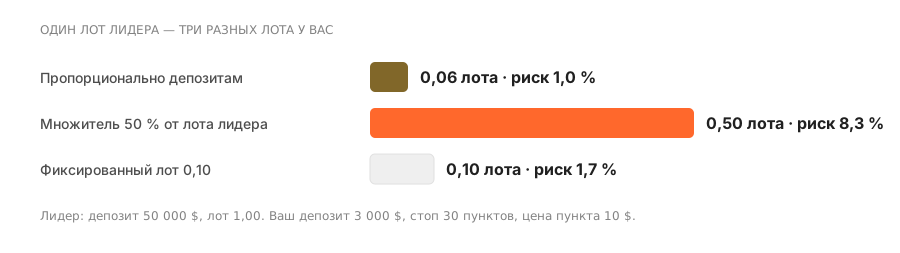
calculate before subscribingProportional to deposits means your percentage risk equals the leader's. A multiplier gives the same strategy at, say, half the risk. A fixed lot breaks the strategy's logic whenever the leader varies their own size.
the main leverHow much of the deposit to give one subscription and how many subscriptions to hold. A practical rule: no single subscription takes more than a third of the copying capital, and the total risk of open trades stays below 5–6 %.
the top levelA loss limit per subscription, an account drawdown threshold, a cap on simultaneous positions, instrument and time filters. Always set, even for a leader you trust.
works without youThe loss limit on a subscription: how to pick the number
The limit is the threshold at which the platform switches copying off by itself. It is set once and before the first trade, because in a drawdown the decision is not made with your head. Three ways to arrive at the number; take the smallest.
Take the maximum drawdown from their card and add half: at 22 % the limit comes out at 33 %. The logic is simple — if the account has gone one and a half times deeper than ever before in its history, this is no longer the strategy you subscribed to.
drawdown × 1.5The amount you can look at without switching copying off in a panic and without deciding to “sit it out”. Before the first drawdown this figure always seems larger than it turns out to be, so it is worth understating.
only experience confirms itThe limit on a subscription and the limit on the account are different numbers. If the subscription takes a third of the capital, then 30 % on it is 10 % on the whole account. Keep the second figure in mind: that is the one you will see in the statement.
convert to the whole accountThree ways give three different numbers, and the right one is the smallest of them. A limit you cannot withstand psychologically is useless, however well founded it may be arithmetically.
the minimum of threeInstrument and time filters: when they break the strategy
Filters look like harmless insurance, but they cut trades out of a connected sequence. A strategy is designed on the assumption that all of its entries and exits are executed, not a selection of them.
| Filter | What it cuts out | How it breaks the strategy |
|---|---|---|
| By instrument | Trades on the chosen pairs | If the lead trader holds the second pair as a hedge, you are left with a naked leg instead of a pair — the risk goes up, not down |
| By time of day | Entries outside the set window | The entry will arrive, the exit outside the window will not. The position stays open with nothing managing it |
| By number of simultaneous positions | Trades above the limit | A grid or averaging strategy will fall short on size and will not be able to close in profit on the move it was designed for |
| By minimum size | Trades below the threshold | Usually safe: it cuts out the lead trader's probing entries, but your statistics will also diverge from the headline figure |
| By direction | Buys only or sells only | Breaks any two-sided strategy outright — half of the logic simply never executes |
The general rule: a filter is acceptable only if it does not break connected trades. Cutting out one instrument entirely is safer than cutting out some of its trades.
The order of setup: what you set and in what sequence
The order is not arbitrary: each next item relies on a number from the previous one. Start from the end and you will have to redo it.
| Step | What you set | Where the number comes from | The cost of a mistake |
|---|---|---|---|
| 1 | Share of capital for the subscription | No more than a third on one lead trader | One lead trader drags the whole account down |
| 2 | Volume calculation mode | Proportional — if you want to repeat the lead trader's risk | A fixed lot breaks position sizing |
| 3 | Copy multiplier | So that the risk per trade comes to 1 % for the duration of the test | The drawdown will be twice as deep as expected |
| 4 | Per-subscription loss limit | The minimum of the three ways above | Switching off will happen in a panic rather than to plan |
| 5 | Filters | None by default | A broken sequence of trades |
| 6 | Length of the test | Two or three months at minimum size | Working size before the first drawdown |
What must not be changed after launch. The sizing mode and the multiplier — on some platforms they alter the size of already-open positions, and the subscription skews. Everything else can be adjusted on the fly: a limit can be tightened, a filter removed, an instrument added. If it is specifically the size you want to change, the cleaner route is to switch copying off, wait for open trades to close, and connect again.
A check before launch. Multiply the per-trade risk from the calculator above by the losing-run length realistic for the strategy — usually 5 to 8 trades. If the result exceeds a quarter of the deposit, the size is too large no matter how good the lead trader is.
Frequently asked questions
What multiplier should a beginner use?
Start with a size where the risk per trade does not exceed 1 % of the deposit, and keep it for at least two months. Increasing size only makes sense once you have seen this strategy's drawdown with your own eyes.
What if the deposit is smaller than the minimum size?
The platform will open the trade at the minimum lot — and your percentage risk will be several times the leader's. This is the main reason a small deposit copying a large trader is more dangerous than it looks.
Should you copy the leader's stop-losses?
Yes, if they set them. Separately, set your own loss limit for the subscription — it protects you if the leader removes the stop and starts sitting out a loss.
How do you configure trade copying in MT4 and MT5?
Through the broker's service, the terminal's built-in signals or a separate copier. In every case three things are configured: the sizing mode, the loss limit and the rules for switching off — the rest is secondary.
Which settings are critical on the first setup?
The volume recalculation mode, the maximum share of the deposit in a subscription, and the stop threshold. Everything else — instrument filters, working hours, caps on the number of positions — can be configured later.
What is a loss limit and how do you set it?
A threshold at which the service stops copying. It is set by the depth of drawdown you are prepared to live through, not by a round number: the most realistic basis is the lead trader's historical maximum drawdown.
Should settings be changed after the start?
Not in the first month. Changing parameters during a drawdown is the commonest reason a subscriber locks in the lead trader's loss without taking part in the recovery that follows.
Are pending orders copied?
It depends on the service: some transfer only market trades, others pending orders too. For strategies built on limit entries this is a fundamental question worth settling before you subscribe.
What should you do if the size is rounded to the minimum?
Either increase the deposit or choose a lead trader who works in smaller sizes. Continuing to copy with the size rounded up means carrying more risk than the lead trader for the same return.
Read next
