Lot calculator: what size your trade will open at
The lot calculator rescales the lead trader's size to your deposit, converts their stop-loss into money and shows the risk as a percentage of the account. Three calculation modes and a check against ten losses in a row.
Working out the lot from the deposit
Four numbers are enough: what you hold, what the lead trader holds, the lot they usually enter with and how many pips their stop is. Below you get your size, the price of the stop in account currency and the share of the deposit at risk.
Pip value is set with a slider: 10 $ is a standard lot of a major currency pair. For other instruments enter your own figure — the derivation table is below.
What the size calculator works out, and by what formula
Three modes give three different answers to the same question. The difference is not convenience but whether you repeat the lead trader's risk or set your own.
Size = lead trader's lot × (your deposit ÷ their deposit). The share of the account at risk matches theirs: with twenty times less money you take 0.05 lots against their 1.00. The only mode in which the strategy works the way its author intended.
repeats the lead trader's riskSize = lead trader's lot × coefficient. A multiplier of 50 % gives the same strategy at half the risk — the entry logic is preserved, the scale shrinks. This is how you connect a lead trader whose drawdown looks too deep for your account.
scales the riskThe size stays constant regardless of what the lead trader entered with. If they vary size themselves — reinforcing a signal or trimming a position — a fixed lot breaks that logic and turns the strategy into a different one.
breaks position sizingLoss = size × stop in pips × pip value. Pip value is its own slider: 10 $ for a standard lot of a major pair, so 0.06 lots with a 40-pip stop gives 24 dollars. Risk per trade as a percentage is the same amount divided by the deposit.
size × pips × pip valueHow to read the lot calculator's result
The three numbers at the top and the verdict beneath them answer different questions. All three have to be read together: an acceptable size at an unacceptable risk is still an unacceptable size.
One trade decides nothing. Take the percentage you got and multiply it by the length of losing run typical for forex strategies — five to eight entries in a row. If the resulting figure looks unacceptable, the size is what has to come down: the lead trader's quality does not change the arithmetic.
How to get the pip value for your instrument
Pip value is the only quantity in the calculation that depends on the instrument, which is why it is a slider. Deriving it takes a minute: it equals the contract size times the pip step, converted into the account currency.
| Instrument type | How the pip value of 1 standard lot is derived | Example |
|---|---|---|
| Pairs of the form XXX/USD — EURUSD, GBPUSD, AUDUSD, NZDUSD | 100,000 × 0.0001 = 10 $. The dollar is the quote currency, so the figure is constant and does not depend on the price. | $10.0 |
| Pairs of the form USD/XXX — USDCHF, USDCAD | 100,000 × 0.0001 ÷ price. The pip is expressed in the quote currency and has to be converted into dollars. | at 0.88 → 11.4 $ |
| USDJPY and other yen pairs | 100,000 × 0.01 ÷ price. The yen has a pip step a hundred times larger than the other majors. | at 150 → 6.7 $ |
| Gold XAUUSD | 100 ounces × 0.01. The contract is smaller than a currency one, so the pip is ten times cheaper. | $1.0 |
| Indices, oil and other CFDs | Contract size × price step. There is no single standard — the figure comes from the contract specification. | different at every broker |
The prices in the examples are round reference points meant to show the order of magnitude: substitute the current price of your own instrument. The exact contract size and pip step are always stated in the broker's specification — at some venues a standard lot of gold is not 100 ounces but some other quantity.
What the size calculator leaves out
The model is deliberately simplified to a single trade. Three things it does not count, and all three work against you.
A loss at the stop equals the stop in the model. On the account, entry and exit costs are added to it, and in a thin market so is the gap between the lead trader's price and yours.
counted separatelyRisk is counted for one trade. If the lead trader holds four positions at once, the total load on the deposit is four times higher — and on correlated instruments it does not cancel out either.
multiplied by the number of tradesSome platforms round the calculated size up to the minimum lot rather than dropping the trade. On a small deposit this systematically inflates your risk relative to the lead trader's.
check the platform's rulesFrequently asked questions
What lot with a deposit of 100 dollars?
In proportional mode, with a typical lead trader holding tens of thousands, the calculated size will come out below the minimum 0.01 lot — and the platform will open the minimum. One such trade with a 40-pip stop costs about 4 $, that is 4 % of your account. Copying a large trader with a hundred dollars is technically possible, but the risk per trade is then several times higher than theirs.
Why does 0.01 lots open instead of the calculated 0.004?
0.01 is the minimum size step at most brokers and cannot be split. The calculated 0.004 is rounded up to the minimum, and your risk as a percentage of the deposit ends up two and a half times higher than the lead trader's. This is not a platform fault but a consequence of mismatched deposits.
Count risk from balance or from equity?
From equity: it accounts for the floating result of open positions. When copying a strategy that holds losing positions, the balance looks untouched while equity has already fallen — and equity is what determines when a stop-out arrives.
How does risk per trade differ from deposit load?
Risk per trade is what you lose if the stop is hit. Deposit load is what share of the account is tied up as margin. You can have 1 % risk at 60 % load: the stop is close but the size is large. Both figures have to be kept within bounds at the same time.
How do you calculate lot size from risk in per cent?
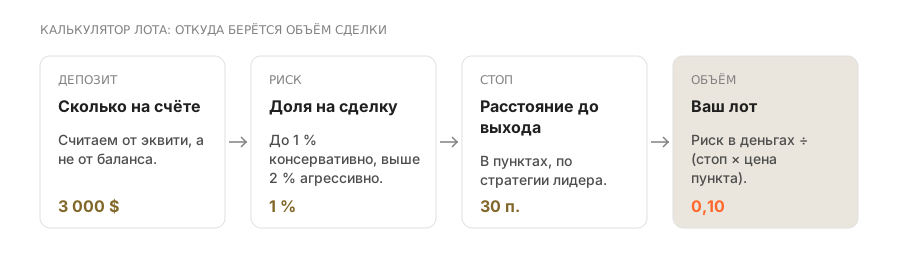
Size = (deposit × risk as a fraction) ÷ (stop in pips × pip value). With a deposit of 3,000, risk of 1 % and a 30-pip stop at a pip value of 10 $, the answer is 0.10 lots.
How much is one pip worth?
On a standard lot of a major currency pair, about 10 $; on a mini lot 1 $; on a micro lot 0.10 $. On crosses, metals and indices the figure differs and is taken from the broker's contract specification.
What risk per trade counts as normal?
Up to 1 % of the deposit is conservative, up to 2 % is the working range, above 5 % and the strategy will survive only a short losing run. Copying adds costs on top, so the margin of safety has to be larger than when trading yourself.
What is the minimum lot and why is it dangerous?
It is the smallest size a broker will execute at all, usually 0.01. If the calculation gives less, the size is rounded up — and your risk ends up above the lead trader's, sometimes several times over.
How do you size lots when copying several traders?
Each subscription is sized against the share of deposit allocated to it, not against the whole account. Otherwise the combined risk comes out several times higher than planned, and margin runs out sooner than expected.
Does the lot change if the deposit grows?
In proportional mode, yes, automatically: the size is recalculated from the current figure. In fixed-lot and multiplier modes the size stays the same, and the risk in per cent gradually falls.
Read next
