Forex trading sessions and copy trading
Forex trading sessions determine what copying will cost: in liquid hours the spread is tight and slippage small, while in a thin market the same lead trader's deal costs a subscriber noticeably more.
Forex market hours: which sessions are open now
Times are shown by your device's clock. The vertical line is the current moment; open sessions are marked in orange.
Session boundaries are conventional: there is no forex exchange, and trading runs continuously from Sunday evening to Friday evening. A session is the hours when the banks of a given region are active. Current UTC time: —.
Why the hour of a trade changes its price for the follower
The leader picks the entry moment from their strategy. You get their trade with a delay and on your own terms — and both depend on the liquidity of that hour.
In Asian hours on European pairs the spread at many brokers is twice as wide as during the London and New York overlap. Every copy pays that cost separately.
the main factorThe thinner the order book, the further the execution price drifts from the leader's. Half a second of copy latency in a thin market costs more than a full second in a liquid one.
multiplied by sizeUS data is released at the start of the American session, European data at the start of the London one. The price jump at publication hits the copy harder than the original.
check the calendarA position carried past midnight server time pays a swap. A strategy that holds trades for days pays it once for every night the copy stayed open.
charged per nightThe cost of copying by hour
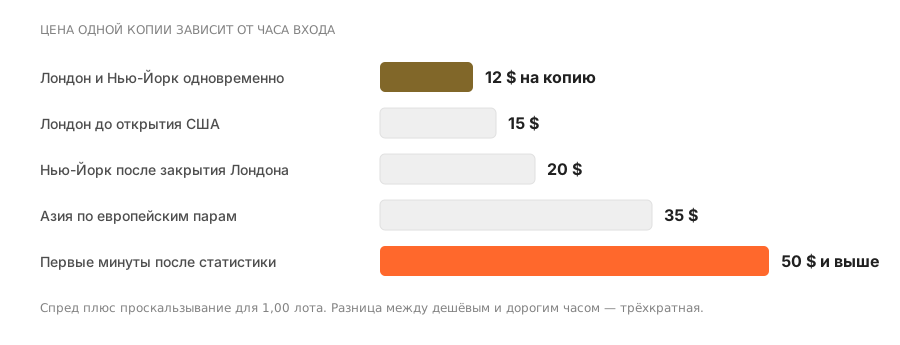
A model estimate for a standard lot of a currency pair: what a single copy costs depending on when the leader opened the trade.
| Period | Liquidity | Typical spread | Slippage | Cost per copy |
|---|---|---|---|---|
| London and New York overlap | high | 1.0 pips | 0.2 pips | $12 |
| London before the US open | high | 1.2 pips | 0.3 pips | $15 |
| New York after London closes | medium | 1.5 pips | 0.5 pips | $20 |
| Asian session on European pairs | low | 2.5 pips | 1.0 pips | $35 |
| The first minutes after a data release | erratic | 3.0 pips and wider | 2.0 pips and wider | 50 $ and above |
Computed for 1.00 lot with a pip worth about 10 $. The exact figures depend on the broker and the instrument — check the contract specification.
Which session to trade in, and what a follower should do about it
Frequently asked questions
When does the forex market open and close?
Trading runs continuously from Sunday evening to Friday evening UTC. The market has no separate opening hours: one region closes, the next opens. Sessions are the hours when the banks of Tokyo, London and New York are active.
Which session is better for copying?
The question is framed wrongly: a strategy is copied whole, not by the hour. The right question is what copying costs during the hours your chosen leader trades, and whether their return covers that cost.
Why is my entry price worse than the leader's?
Time passes between their trade and yours: the signal reaches the platform, the platform places an order with your broker, the broker fills it at its own price. In a thin market the price moves further during those fractions of a second.
Does the broker's time zone affect the swap?
Yes. The swap is charged at midnight server time, not yours. Brokers with different server zones charge it at different moments, and a strategy that closes trades in the evening will pay a swap at one broker and not at another.
What trading sessions exist in forex?
Asian, European and American. The boundaries are conventional: there is no single exchange, trading runs continuously, and a session is the hours when the banks of a given region are active.
When is forex liquidity highest?
In the hours when London and New York are open at the same time. The spread is at its tightest then, and slippage in copying at its smallest.
Is it worth copying at night?
Copying cannot be switched on by the hour without breaking the strategy. But it is useful to know that a lead trader works in a thin market: their costs, and therefore yours, are substantially higher there.
Why is the spread wider in the Asian session?
Fewer participants on European pairs means less market depth. On yen pairs in the same hours the picture is reversed: there the session is precisely the active one.
Do weekends affect copying?
The market is closed, trades are not broadcast, and open positions carry over the weekend with a swap and the risk of a gap at Monday's open.
What is a gap and is it dangerous in copying?
A price break between the market's close and its open. It is dangerous because a stop-loss fills at the first price available beyond the gap rather than at its own level — and the loss comes out larger than planned.
Read next
