Darwinex: a strategy as an index and an external risk engine
Darwinex does not broadcast someone else's trades directly — the platform packages a trader's strategy into a DARWIN index and normalises its risk with its own engine. We look at what this changes for the investor and why the format is closer to a fund than to copying.
What a DARWIN is and what it is not
The platform calls its instruments DARWINs — a trading strategy packaged as a managed index. You are not buying a subscription to a trader but a share in an index whose risk is levelled by the platform's risk engine, operating independently of the strategy's author.
The key difference from MQL5 or ZuluTrade: there your result mirrors the leader's, give or take latency and size. Here a layer sits between you and the trader that deliberately alters their risk, bringing different strategies to a comparable level so they can be compared like for like.
The platform's risk engine and uncorrelated strategies
The platform warns that 53 % of retail investor accounts lose money when trading CFDs with this provider — the figure is as at our verification date and is recalculated quarterly. Regulation runs through separate entities in the UK and the EU.
Darwinex: short answers
- How a DARWIN differs from a signal subscription
- It is an index, not an order feed. The platform normalises the strategy's risk, so your result differs from the author's in both return and drawdown.
- Who this format suits
- Anyone building a portfolio of uncorrelated strategies who is willing to assess them as investment instruments rather than as “a trader with a pretty curve”.
- What about liquidity
- The indices are built from liquid instruments, and the portfolio value is visible in the investor app during trading hours.
- Do you need MetaTrader
- Not as an investor: everything runs through the platform's own tools. Strategy authors connect their trading accounts separately.
Fees, minimum amounts and access rules depend on the legal entity and change — check them on the platform's site.
Frequently asked questions
Is this copy trading or a fund
Formally it is copying; mechanically it is closer to an index product. You receive not one person's trades but the result of a strategy normalised to a standard level of risk.
Can the risk engine be treated as a guarantee
No. It caps the strategy's risk but does not cancel market losses: a strategy can lose money steadily while staying within acceptable risk.
Why the entry threshold is higher than at broker services
The format is aimed at a portfolio investor, not at a $50 trial subscription. That is a deliberate choice of audience, not a technical limit.
What is a DARWIN in Darwinex?
An instrument built on top of a trader's deals and brought by the platform to a single risk level. You subscribe to it rather than directly to the author's account.
How is the Darwinex rating calculated?
From several components: consistency of results, handling of losses, and adherence to the declared style. Looking only at the headline score throws away the very information it was broken down to reveal.
Why normalise risk?
So that strategies become comparable: "40 % a year" from two authors starts to mean something similar. The side effect is that a DARWIN's result differs from the trader's account result.
What is the entry threshold at Darwinex?
Higher than at broker-run services: the format is built for a portfolio investor, not for a trial subscription. Check current amounts on the platform.
Is this copy trading or a fund?
Closer to an investment instrument than to ordinary copying: the platform's model sits between you and the author's trades. The legal structure is worth reading in its own documents.
Who is Darwinex not for?
Anyone who wants a quick, simple start: the format demands understanding how the rating is built and what risk normalisation does.
How investing in DARWINs works
Darwinex is built differently from an ordinary showcase: you subscribe not to a trader's account but to an instrument built on top of their trades.
A DARWIN is a strategy brought by the platform to a single risk level. Your return does not repeat the author's account return: it is recalculated so that risk is comparable across different strategies.
an instrument, not an accountThe score is made up of several components: consistency of results, handling of losses, and adherence to the declared style. Looking only at the headline score means losing the very information it was broken down to reveal.
read it part by partThe normalisation model creates no data: on a strategy with a short track record a high score means only that things went well over that short time.
track record beats scoreBringing everything to a common risk level makes comparison and portfolio-building easier, but it does not remove correlation: two strategies on the same pairs remain linked.
correlation remainsWho Darwinex suits and who it does not
Other copying venues
Nine services examined to one template: where the trade executes, whether a terminal is required, how the fee is computed and what happens with statistics verification.
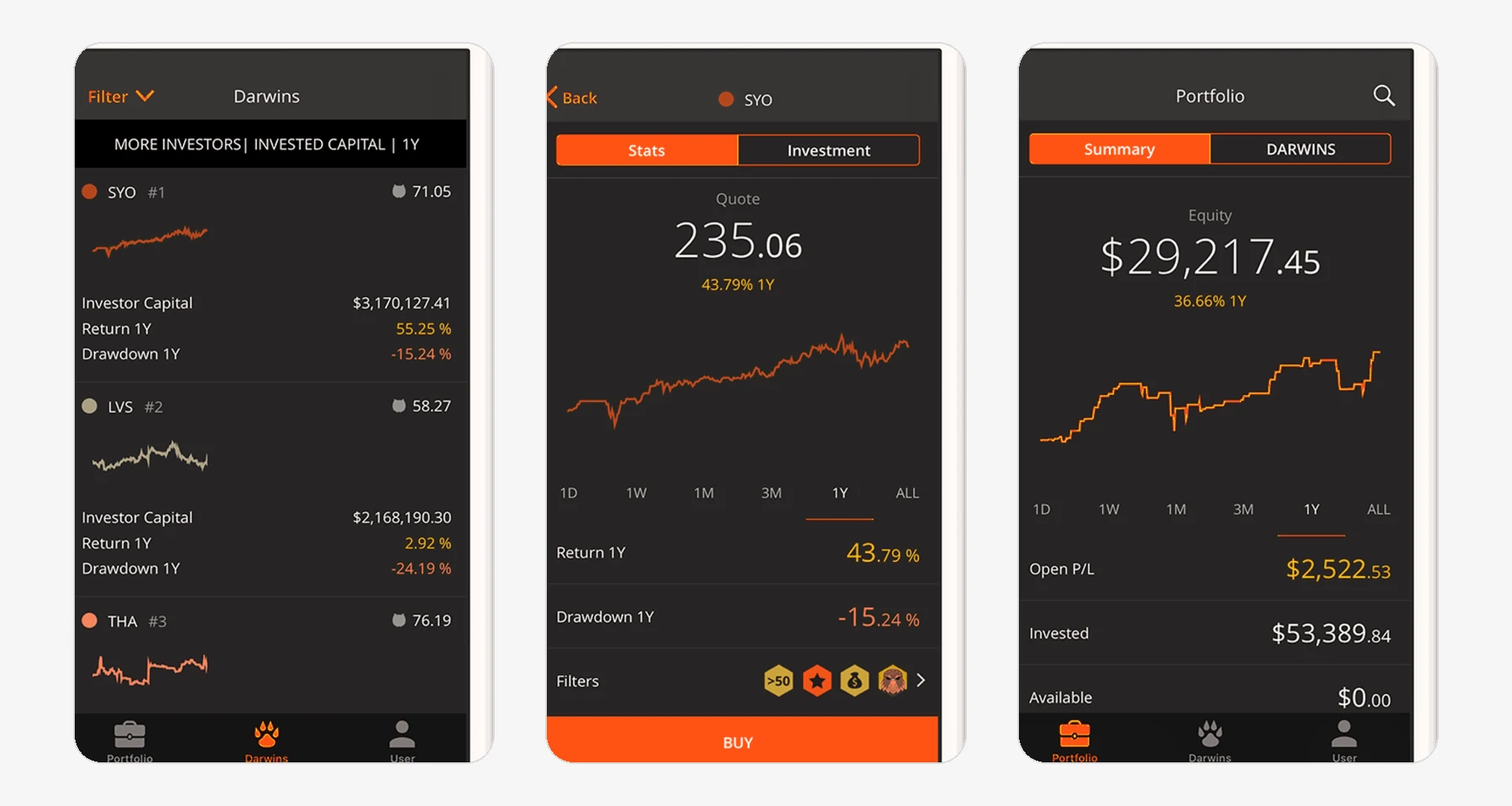
An official app screenshot from the platform: the interface is real, the figures in it are illustrative and promise nothing. Colours mapped to the site palette, avatars blurred.
Read next
